


The AI infrastructure trade still has momentum, but it is becoming less of a pure technology story and more of a resource-security story. The market continues to reward the compute layer: the latest data show SOXX up 29.9% over one month with roughly $509M of inflows, AIQ up 23.4% with about $431M of inflows, TCAI up 22.4% with $72M of inflows, and IGV up 20.9% with nearly $2.9B of inflows. That matches the news backdrop of new AI models, business-focused AI tools, data-center commitments, AI-driven cybersecurity demand and continued enthusiasm around the broader AI capex cycle.
But the same news headlines also show why the trade may be vulnerable. AI infrastructure depends on cheap and reliable power, available water, metals, grid equipment, cooling systems, permits and financing. Those are not software variables. They are physical constraints.
The market is starting to recognize that bottleneck. GRID, a smart-grid infrastructure ETF, was up only 3.3% over the past month, but it attracted roughly $1.26B of one-month inflows and more than $4.4B year to date. KOPX, a copper miners ETF, rose 18.5% over one month with about $350M of inflows. Those flows fit the news: AI demand is pulling investors toward the picks-and-shovels assets needed to connect data centers to the real world.
Power is the first vulnerability. The IEA expects global data-center electricity consumption to more than double to roughly 945 TWh by 2030, with AI as the most important driver; in the U.S., data centers are expected to account for nearly half of electricity-demand growth through 2030. That makes the AI trade exposed to grid interconnection delays, transformer shortages, higher energy prices and local resistance to new power infrastructure.
Copper is the second vulnerability, though not a simple one. S&P Global has argued that AI, data centers and defense will add materially to copper demand, while Reuters noted on June 3 that the copper bull case could be limited by grid delays, power constraints, infrastructure bottlenecks and design changes that reduce copper intensity. That is the key point for investors: copper can benefit from the AI build-out, but the build-out itself can be slowed by the same physical bottlenecks that make copper attractive.
Water may be the most underpriced risk. North American data centers used nearly 1 trillion liters of water in 2025, and investors have been pressing Amazon, Microsoft and Google for better disclosure on water and power use. Google’s June 3 water standards also reflect rising community pressure around data-center water consumption, power costs, pollution and noise. Yet water ETFs are not acting like core AI beneficiaries: PHO fell 2.7% over one month with roughly $21.7M of outflows, FIW fell 2.2% with about $10.1M of outflows, CGW declined 3.1%, PIO fell 3.7%, and TBLU dropped 4.6%. That disconnect suggests water access remains treated as an ESG or utility niche, not as a strategic AI bottleneck.
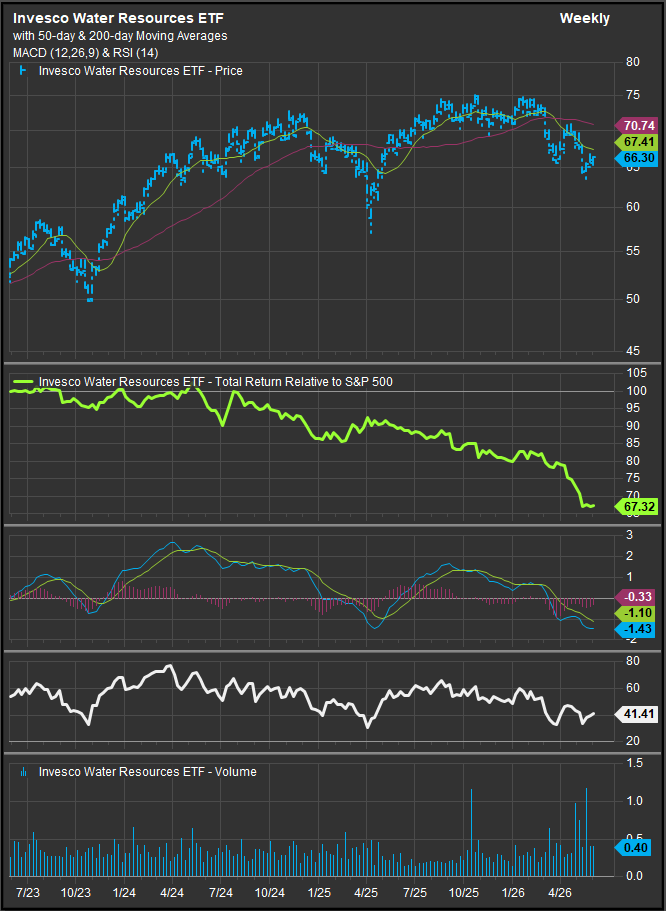
Unlike power generation, base metal inputs and compute capability, investors are showing complacency towards water availability.
Water-linked ETF performance and flows
| Ticker | Fund | AUM | 1D Return | 1W Return | 1M Return | 3M Return | 6M Return | 1D Flow | 1W Flow | 1M Flow | YTD Flow | 1Y Flow |
| PHO | Invesco Water Resources ETF | $1.98B | 0.73% | 0.61% | -2.71% | -8.76% | -7.77% | $0.0M | $0.0M | -$21.7M | $22.4M | -$84.8M |
| FIW | First Trust Water ETF | $1.76B | 0.45% | 0.72% | -2.15% | -7.94% | -6.21% | $0.0M | -$5.2M | -$10.1M | -$47.3M | -$20.5M |
| CGW | Invesco S&P Global Water Index ETF | $0.98B | 0.93% | -0.85% | -3.08% | -8.04% | -1.40% | $0.0M | $0.0M | $0.0M | $25.8M | $15.4M |
| PIO | Invesco Global Water ETF | $0.27B | -0.23% | -0.06% | -3.73% | -7.72% | -1.58% | $0.0M | $0.0M | $0.0M | -$2.7M | -$2.7M |
| TBLU | Tortoise Global Water ETF | $0.05B | 0.97% | -1.23% | -4.64% | -10.58% | -3.80% | $0.0M | $0.0M | $0.0M |
The most vulnerable parts of the AI infrastructure trade are therefore not necessarily the best chip companies. The greatest risk sits in high-density data-center projects in hot or water-stressed regions; developers relying on cheap power and smooth permitting; equipment and server suppliers priced for uninterrupted deployment; and financing structures that assume capex can keep rising without commodity, energy or community pushback.
The trade can still work, but the next phase should reward the companies that solve scarcity, not just those that consume resources. Grid equipment, power management, cooling, water efficiency, copper supply and permitting advantage may become as important to the AI build-out as chips and models. The market has already priced the digital ambition. It is only beginning to price the physical constraints.
