


Nvidia just answered one of the biggest questions hanging over the thematic market: the AI capital-spending cycle is not rolling over.
The company forecast 70% revenue growth for fiscal 2028, dramatically above the roughly 44% Wall Street had expected. Data-center revenue more than doubled to $89 billion, Amazon committed to deploy another 2 million Nvidia GPUs in 2027 and 2028, and management said demand remains supply-constrained even at Nvidia’s extraordinary scale. Nvidia expects AI labs alone to represent roughly a quarter of its business next year. (Reuters)
The August 27 ETF flow data provides an interesting setup because it largely captures positioning before Wednesday night’s Nvidia report and before Fed Chair Kevin Warsh’s Friday speech at Jackson Hole. Investors were already rebuilding semiconductor exposure while simultaneously increasing allocations to biotech, dividends, precious metals and lower-volatility strategies. The market is therefore entering the second half of 2026 with a barbell: renewed conviction in AI earnings on one side and growing protection against Fed, inflation and valuation risk on the other.
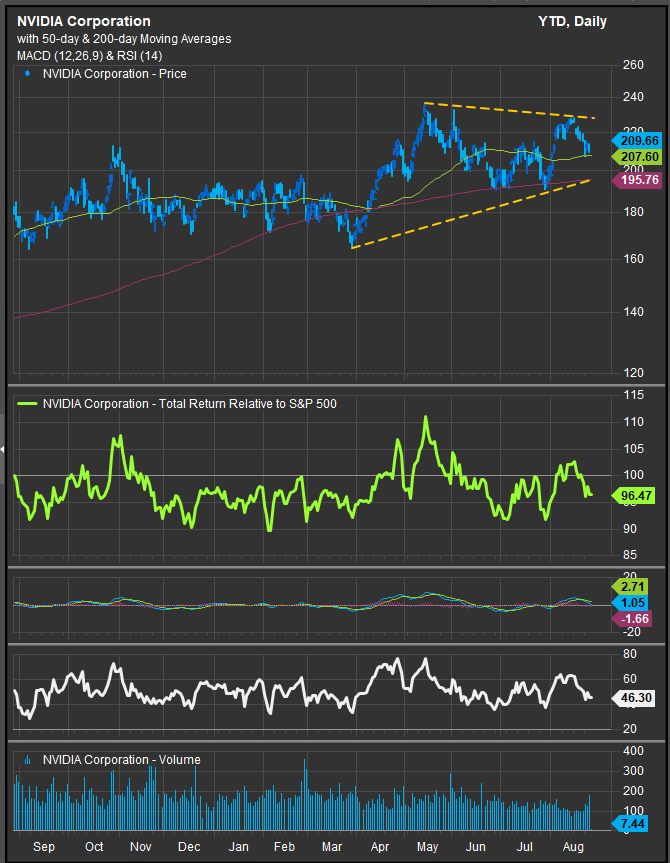
Chart: NVDA has been in an intermediate-term consolidation pattern since May. The technical read is that the chart improves materially on a move above $230 which would confirm the uptrend. Stock is >7% higher in the pre-market this morning.
Semiconductor Flows Were Turning Before Nvidia Delivered
The most important reversal in this week’s data is semiconductors. After several weeks of aggressive profit-taking, semiconductor ETFs attracted approximately $2.4 billion over the latest week, even though the median fund declined about 1.6%. VanEck Semiconductor ETF (SMH) attracted approximately $2.01 billion, while iShares Semiconductor ETF (SOXX) received another $294 million and Invesco PHLX Semiconductor ETF (SOXQ) approximately $105 million. The category now retains roughly $20.6 billion of YTD inflows. That is significant because investors were buying before knowing how strong Nvidia’s guidance would be. The earnings report now validates the fundamental assumption behind those flows: demand for AI compute remains much stronger than the recent semiconductor correction implied.
Thursday’s market reaction confirms that interpretation. Nvidia rose sharply in premarket trading while Micron, Marvell, Broadcom and other AI suppliers gained after the forecast. Reuters noted that the results specifically challenged the idea that the AI capex cycle is already peaking. (Reuters) There are still reasons for discipline. Nvidia expects gross margins to decline as memory and other component costs rise, China remains uncertain, and Washington is considering additional semiconductor tariffs. But the critical question for the AI trade has shifted. Investors no longer need to ask whether demand is weakening; they need to decide how much of extraordinarily strong future demand is already reflected in valuations.
Software Finally Shows That AI Can Create Winners, Not Just Victims
The more important development for broader market leadership may be occurring in software. Software ETFs attracted approximately $91 million this week and $763 million over one month, even though weekly performance was subdued. Within the category, the money is concentrating in areas where AI creates identifiable revenue rather than disruption risk. First Trust Nasdaq Cybersecurity ETF (CIBR) attracted approximately $165 million this week, while Global X Cybersecurity ETF (BUG) gathered $78 million. Broad software exposure through IGV lost roughly $164 million, showing that investors are still differentiating sharply within the industry.
The earnings support that distinction. Salesforce raised annual forecasts as demand for Agentforce accelerated and expanded its Anthropic relationship through Claudeforce. CrowdStrike raised its revenue outlook on strong cybersecurity demand, while Synopsys increased forecasts as AI-driven semiconductor and infrastructure investment boosts demand for chip-design software. (Reuters) This is important for the next phase of AI leadership. Earlier in the cycle, the easiest winners were the companies selling GPUs, networking hardware and data-center equipment. The latest results increasingly show AI producing revenue in security, enterprise software and design tools.
Nvidia is therefore not just extending the hardware cycle. Its quarter strengthens the argument that AI leadership can broaden.
Broad AI Funds Are Positive—but Investors Are Still Selective
Dedicated robotics and AI ETFs attracted only about $29 million during the latest week, although one-month flows remain positive at approximately $520 million and YTD inflows approach $4.9 billion. That gap between semiconductor buying and broad AI buying is telling. Investors are not responding to every positive AI headline with indiscriminate allocations. They are favoring areas where current earnings provide evidence of monetization. The iShares A.I. Innovation and Tech Active ETF (BAI) attracted approximately $39 million this week and nearly $400 million over one month, while several robotics-oriented portfolios experienced small or negative flows.
The AI story has therefore become more fundamental. Nvidia’s 70% forecast, Salesforce’s improving Agentforce metrics and CrowdStrike’s security demand provide actual revenue evidence. That is a stronger foundation for the theme than another expansion in private-company valuations.
Fed Positioning Looks Like a Hedge, Not a Bet on Easing
The second major message in the August 27 data is that investors are not making a large directional bet that the Fed will become dovish in the second half. July PCE inflation came in slightly hotter than expected, leaving headline inflation at 3.7% and reinforcing uncertainty about whether the Fed will need another rate increase. Markets currently put the probability of a September hike around the mid-30% range, with a substantially greater probability of tightening by December. (Reuters)
ETF positioning reflects that uncertainty. The iShares Core U.S. Aggregate Bond ETF (AGG) attracted only about $49 million this week, although one-month inflows remain positive at $574 million. That is hardly evidence of investors aggressively extending duration in anticipation of easier policy. Instead, capital is moving into dividends, free cash flow and alternative hedges. Schwab U.S. Dividend Equity ETF (SCHD) attracted approximately $760 million this week and $4.0 billion over one month. VictoryShares Free Cash Flow ETF (VFLO) received another $241 million, extending its monthly inflow to roughly $857 million. Investors want equity participation, but increasingly with cash-flow support.
Gold Is the Strongest Fed Hedge
Precious-metal flows provide the clearest evidence that investors are uncomfortable with the policy outlook. Gold bullion exposure attracted approximately $1.55 billion during the latest week and $5.1 billion over one month, even though its YTD flow remains deeply negative. Silver added roughly $194 million this week and $662 million over one month. That represents a major reversal from earlier-year positioning.
Gold’s appeal is not simply that investors expect rate cuts. In fact, conventional rate expectations remain relatively hawkish. Reuters notes that the recent gold rally has been supported by broader concerns about government debt, dollar debasement and uncertainty surrounding the relationship between Treasury policy and the Fed. Investors now want Warsh to clarify both his commitment to the 2% inflation target and his view of the bond market’s role in monetary policy. (Reuters) Gold is therefore behaving less like a straightforward falling-rates trade and more like insurance against policy uncertainty.
Biotech Adds Another Leg to the Barbell
Biotechnology remains the strongest emerging theme outside AI. The category attracted approximately $764 million this week and more than $1.0 billion over one month, while major biotech ETFs continued outperforming. IBB attracted about $55 million, ARK Genomic Revolution ETF (ARKG) received approximately $148 million, and other genomics and breakthrough-therapy portfolios also gathered assets. This matters for Fed positioning because biotech combines improving clinical fundamentals with substantial interest-rate sensitivity. Investors can participate in recent drug-development and M&A catalysts while retaining exposure to an asset class that would benefit disproportionately if Warsh ultimately adopts a less hawkish stance. Biotech is therefore complementing AI rather than replacing it. AI represents earnings acceleration; biotech provides a mix of fundamental catalysts and rate optionality.
The Flow Message
Nvidia’s quarter materially strengthens the AI investment thesis. A 70% forward revenue-growth forecast, accelerating demand beyond hyperscalers and Amazon’s enormous new GPU commitment argue that the compute cycle has years rather than quarters left to run. Semiconductor ETF investors had already begun rebuilding exposure before the report, making this week’s $2.4 billion semiconductor inflow an important confirmation signal. But investors are not returning to the 2025-style strategy of simply maximizing growth exposure. QQQ lost approximately $2.6 billion this week, VGT lost roughly $781 million, while dividends, free cash flow, biotech and precious metals attracted substantial capital. That combination describes second-half positioning better than either “risk-on” or “risk-off.”
Investors believe AI earnings are real, but they also believe Fed uncertainty is real. They are rebuilding exposure to semiconductors and AI monetization while simultaneously owning income, cash flow, biotech and gold as protection against higher rates, persistent inflation and policy uncertainty. Nvidia has removed one major doubt from the market: AI demand has not peaked. Warsh now has to address the other one—how expensive money will be while investors finance the next stage of that boom.
ETF return and fund-flow data through August 26, 2026. CSV data sourced from FactSet Research Systems Inc.
Sources
- FactSet Research Systems Inc. — August 27, 2026 thematic ETF return and fund-flow data used for the report’s semiconductor, AI, software, biotech, dividend, precious-metal and broad-market positioning analysis.
- Reuters — Aug. 27: Nvidia forecast approximately 70% revenue growth next fiscal year, reinforcing expectations that AI-chip demand remains exceptionally strong into 2028.
- Reuters — Aug. 26: Salesforce raised its annual revenue and profit outlook and expanded its Anthropic partnership through Claudeforce, providing additional evidence of enterprise AI monetization beyond hardware.
- Reuters — Aug. 26: Synopsys raised annual forecasts as AI-related semiconductor and infrastructure investment increased demand for chip-design software.
- Investor’s Business Daily / MarketWatch — Aug. 27: CrowdStrike reported strong revenue and recurring-revenue growth as AI-related cybersecurity threats increased enterprise demand.
- Reuters — Aug. 27: Gold remained supported ahead of Fed Chair Kevin Warsh’s Jackson Hole speech as investors weighed persistent inflation, fiscal concerns and uncertainty about the Fed’s policy framework.
- Reuters — Aug. 26–27: July PCE inflation rose 3.7% year over year, slightly above expectations, leaving markets uncertain about September but still pricing meaningful odds of another Fed hike by year-end.
- Reuters — Aug. 27: The administration is considering another broad round of semiconductor tariffs that could include chips, laptops, servers and other technology equipment, introducing an additional policy risk for the AI supply chain.
- Reuters — Aug. 27: Strait of Hormuz traffic improved modestly but remained below recent averages, preserving geopolitical uncertainty around energy and inflation.
