

Investors are responding to improving technology and economic news, but not with an indiscriminate return to risk.
Palantir’s second-quarter results offered some of the clearest evidence that enterprise and government artificial-intelligence spending is translating into measurable revenue. U.S. commercial revenue increased 149% from a year earlier, government revenue rose 90%, and the company raised its full-year outlook. Google’s reported infrastructure-financing initiative supporting Anthropic further underscored the scale of capital still being committed to AI development.
ETF investors are buying that message. Capital is moving into large, liquid semiconductor funds, selected AI portfolios, software and power infrastructure. At the same time, investors continue to withdraw money from more speculative innovation funds, broad clean-energy strategies, homebuilders and generic infrastructure exposure.
The result is a more selective thematic market. Investors still believe in innovation, but they increasingly want visible revenue, control of scarce physical capacity or immediate cash-flow support.
AI Flows Are Following Revenue
The strongest corporate news is coming from businesses that can demonstrate actual AI adoption rather than merely promise future exposure.
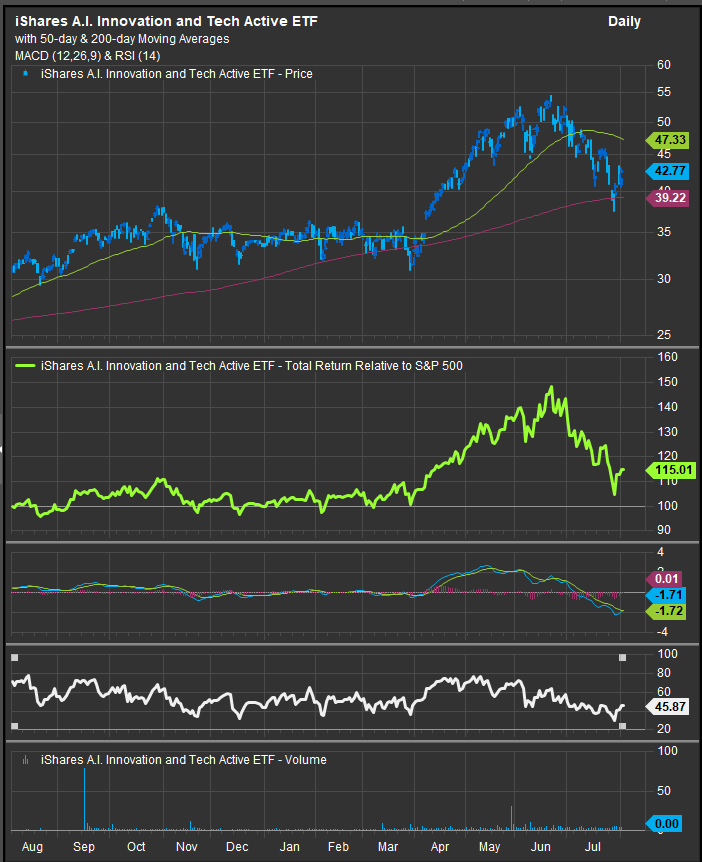
The iShares A.I. Innovation and Tech Active ETF (BAI) rebounded 7.6% over the latest week and attracted approximately $257 million. Its one-month return remained negative at 9.0%, but monthly inflows reached roughly $691 million. The Global X Artificial Intelligence & Technology ETF (AIQ) and Global X Robotics & Artificial Intelligence ETF (BOTZ) also recorded positive weekly and monthly flows.
That buying contrasts with continued withdrawals from more speculative innovation portfolios. The ARK Innovation ETF (ARKK) lost approximately $101 million over the latest week and $278 million over the month. The ARK Autonomous Technology & Robotics ETF (ARKQ) experienced approximately $33 million of weekly outflows and $21 million over one month.
Investors are not returning to every fund associated with artificial intelligence. They are favoring portfolios containing established technology companies, identifiable enterprise customers and clearer paths from AI spending to earnings.
Palantir’s results reinforce that distinction. Accelerating commercial and government demand suggests that AI is generating operating revenue in software, defense and data analytics. The remaining risk is that expectations and valuations may already discount a considerable amount of future growth.
Semiconductors Remain the Highest-Conviction Trade
Semiconductor funds continue to produce the largest divergence between price performance and investor positioning.
| ETF | Theme | 1-Week Return | 1-Week Flow | 1-Month Return | 1-Month Flow |
| SMH | Semiconductors | +3.0% | +$4.26B | -7.9% | +$4.21B |
| SOXX | Semiconductors | +3.3% | +$2.74B | -10.4% | +$8.23B |
| BAI | Artificial Intelligence | +7.6% | +$257M | -9.0% | +$691M |
| IGV | Software | +6.2% | +$483M | +4.1% | -$472M |
| GRID | Grid Infrastructure | +5.5% | +$69M | -1.2% | +$260M |
| FCG | Natural-Gas Equities | +5.3% | +$9M | +10.0% | +$10M |
The iShares Semiconductor ETF (SOXX) attracted approximately $8.23 billion over one month despite losing 10.4%. The VanEck Semiconductor ETF (SMH) received approximately $4.26 billion during the latest week alone.
However, the buying is becoming concentrated. The First Trust Nasdaq Semiconductor ETF (FTXL) lost approximately $180 million over the latest week and $885 million over the month. Investors appear to prefer the scale, liquidity and mega-cap exposure of SOXX and SMH rather than buying the entire semiconductor industry equally.
The global memory shortage supports the industry’s pricing and utilization outlook, but it also introduces risks. Major PC manufacturers have reportedly begun purchasing some memory chips from China’s CXMT as DRAM and high-bandwidth-memory capacity remains constrained. Industry reporting indicates that significant capacity may already be committed through 2027.
That scarcity supports semiconductor pricing, but rising memory costs could pressure PC makers, server manufacturers and smaller hardware companies. The AI hardware trade therefore remains compelling but crowded: large inflows show conviction, while also demonstrating that the recent correction has not fully cleared investor positioning.
Software Rebounds, but Investors Take Profits Selectively
Software funds rallied sharply during the latest week, supported by Palantir’s results and continued evidence of enterprise AI demand.
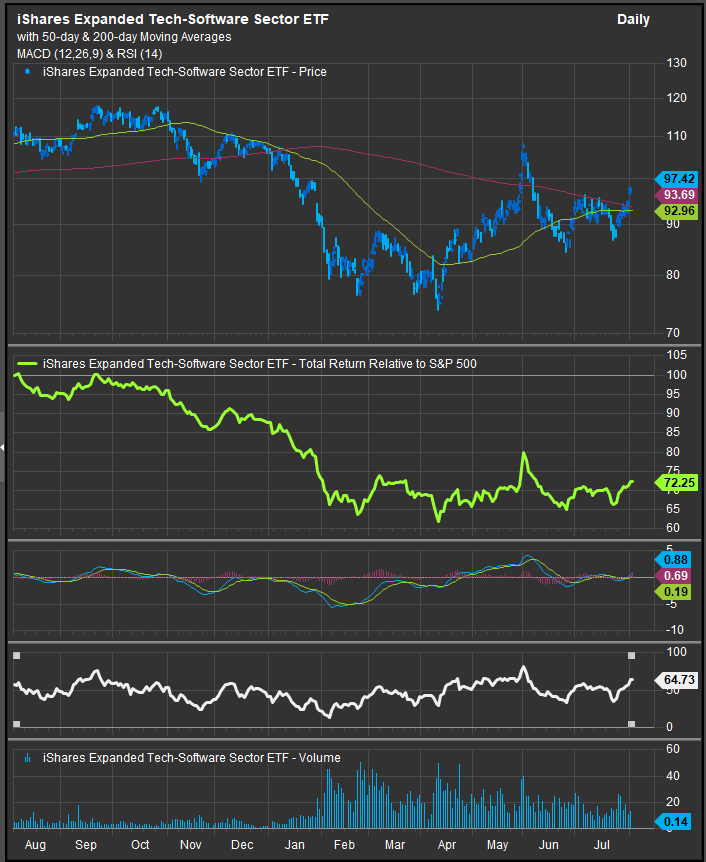
The iShares Expanded Tech-Software Sector ETF (IGV) gained 6.2% and attracted approximately $483 million over the week. However, the fund still recorded roughly $472 million of one-month outflows.
Cybersecurity flows show a similar transition. The First Trust Nasdaq Cybersecurity ETF (CIBR) and Global X Cybersecurity ETF (BUG) retained one-month inflows of approximately $181 million and $150 million, respectively, but both experienced withdrawals during the latest week.
Cloud and internet funds delivered strong returns without attracting equivalent capital. The First Trust Cloud Computing ETF (SKYY) gained 9.7% over one month but lost approximately $80 million. The First Trust Dow Jones Internet Index Fund (FDN) rose 5.9% while experiencing roughly $249 million of monthly outflows.
The news is improving faster than the positioning. Investors were willing to buy the latest software rebound through IGV, but they also took profits from cloud, internet and cybersecurity portfolios that had previously held up better than semiconductor hardware.
The flow pattern suggests that investors want evidence of monetization. Software companies demonstrating stronger bookings, customer retention and enterprise productivity gains are being treated differently from businesses whose AI potential remains largely prospective.
The Manufacturing Boom Is Not Producing a Broad Infrastructure Bid
July’s ISM Manufacturing Index increased to 55.6, its highest reading since May 2022. New orders expanded for a seventh consecutive month, production accelerated and manufacturing employment moved above 50 for the first time in 33 months.
Survey respondents identified AI infrastructure, semiconductors, data centers and defense as important demand drivers. They also warned that tariffs, geopolitical tensions and shipping disruptions were increasing freight, energy and sourcing costs.
ETF investors are responding by targeting specific bottlenecks rather than buying broad industrial exposure.
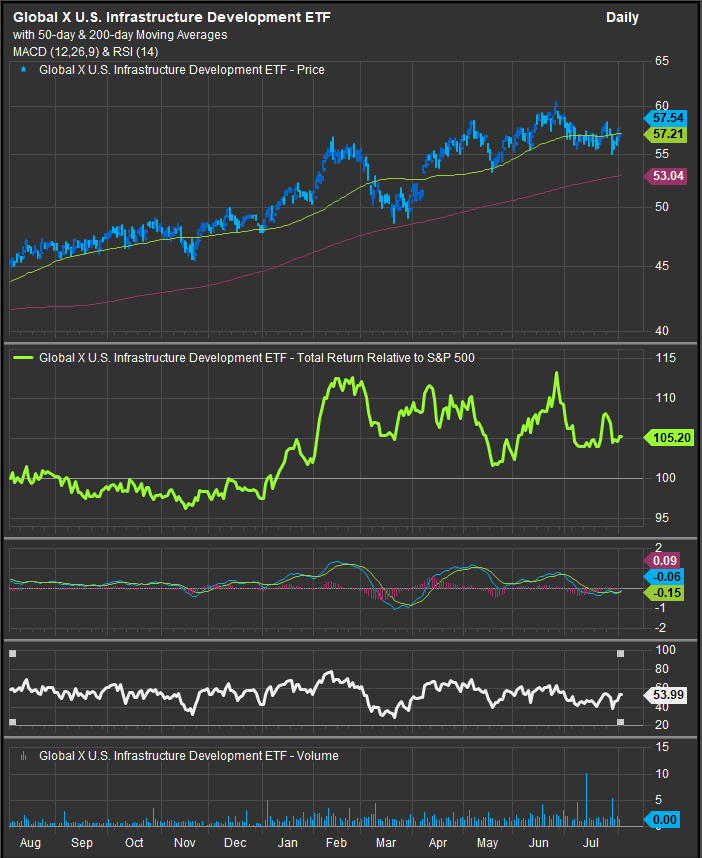
The Global X U.S. Infrastructure Development ETF (PAVE) lost approximately $146 million over the latest week and $320 million over the month. The iShares U.S. Home Construction ETF (ITB) declined 5.7% over one month while experiencing approximately $420 million of outflows.
By contrast, the First Trust Nasdaq Clean Edge Smart Grid Infrastructure Index Fund (GRID) attracted approximately $69 million during the latest week and $260 million over the month. The iShares U.S. Power Infrastructure ETF (POWR) received approximately $47 million over one month.
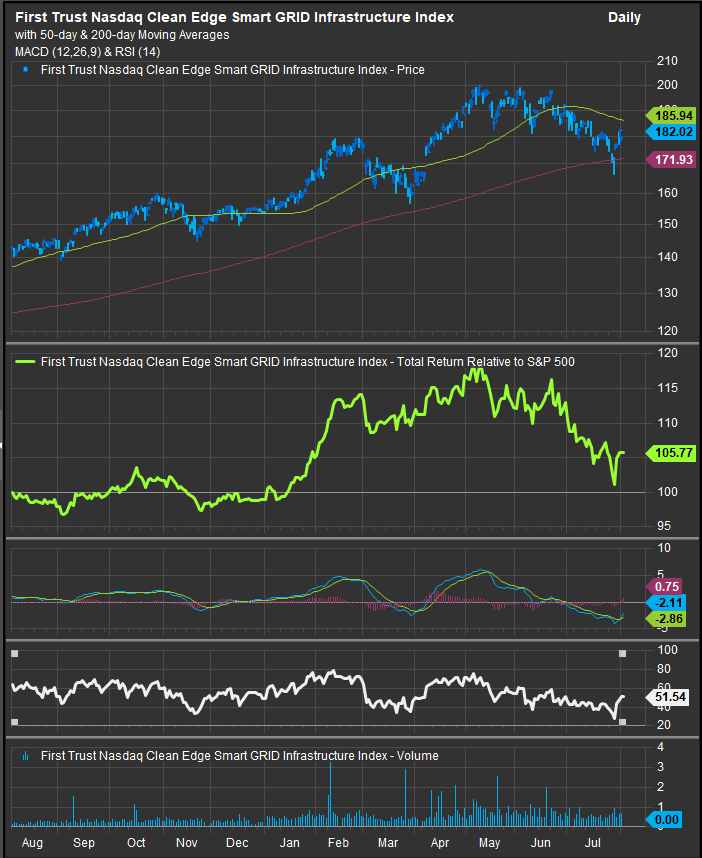
This is one of the clearest second-order AI trades in the flow data. Investors are not broadly buying construction, housing or infrastructure. They are allocating specifically toward the transmission equipment, electrical systems and grid capacity required to support data-center development.
The message is that not all infrastructure will benefit equally. Investors prefer areas where demand is urgent, capacity is constrained and spending is difficult to postpone.
Electrification Wins While Broad Clean Energy Loses Assets
The divergence between electrification and traditional clean energy continues to widen.
The iShares Global Clean Energy ETF (ICLN) declined 8.5% over one month and experienced approximately $228 million of outflows, including almost $95 million during the latest week. The First Trust Nasdaq Clean Edge Green Energy Index Fund (QCLN) lost 11.0% and approximately $101 million over the month.
GRID, by comparison, declined only 1.2% over the month while attracting substantial capital.
Investors are separating rising electricity demand from broad environmental themes. The AI buildout requires more generation, transmission, cooling equipment and grid reliability regardless of whether the marginal power source is renewable energy, nuclear power or natural gas.
That makes grid infrastructure a physical-capacity theme. Broad clean-energy funds remain more exposed to financing costs, policy uncertainty, project economics and changes in government support.
The market is therefore shifting away from an all-encompassing energy-transition narrative and toward the equipment and infrastructure required to deliver dependable electricity.
Geopolitical Hedges Are Being Rotated, Not Abandoned
Conflicting U.S. and Iranian statements continue to reduce confidence in a durable diplomatic resolution. Iran has characterized its discussions as talks with Oman concerning the Strait of Hormuz, while the U.S. has continued to suggest that broader negotiations could take place.
ETF positioning indicates that investors are retaining geopolitical and inflation hedges, but they are becoming more selective about which exposures they own.
The First Trust Natural Gas ETF (FCG) gained 10.0% over one month and attracted modest positive flows. The VanEck Oil Services ETF (OIH) rose 6.3% during the month but lost approximately $76 million over the latest week and $117 million over one month.
The difference suggests that investors are not simply buying every energy-related portfolio in response to higher geopolitical risk. They appear more interested in companies with direct exposure to constrained production and commodity prices than businesses dependent on a broader recovery in drilling and capital spending.
Precious-metals positioning is also mixed. The iShares Silver Trust (SLV) attracted approximately $209 million during the latest week and $366 million over one month despite a 4.7% monthly decline. The VanEck Gold Miners ETF (GDX) retained approximately $149 million of monthly inflows, although it experienced modest weekly withdrawals.
Defense exposure shows the same selectivity. The Invesco Aerospace & Defense ETF (PPA) received approximately $38 million over one month, while the iShares U.S. Aerospace & Defense ETF (ITA) recorded approximately $82 million of monthly outflows.
Investors are maintaining protection against geopolitical escalation, inflation and resource scarcity. They are not, however, adding capital indiscriminately to every traditional hedge.
Cash Flow Remains the Portfolio Anchor
The strongest non-technology positioning continues to favor dividends, value and free cash flow.
The Schwab U.S. Dividend Equity ETF (SCHD) attracted approximately $1.01 billion over the latest week and $2.99 billion over one month. The iShares MSCI EAFE Value ETF (EFV) received approximately $517 million during the week and $3.71 billion over the month.
The Capital Group Dividend Value ETF (CGDV) gathered approximately $730 million over one month, while the Vanguard High Dividend Yield ETF (VYM) received roughly $645 million.
Free-cash-flow strategies were also strong. The VictoryShares Free Cash Flow ETF (VFLO) gained 6.4% over one month and attracted approximately $705 million, including $271 million during the latest week.
Momentum investors are beginning to rebuild positions as well. The Invesco S&P 500 Momentum ETF (SPMO) attracted approximately $197 million during the week and $698 million over the month despite remaining down 3.6% for the period.
The iShares MSCI USA Momentum Factor ETF (MTUM) received approximately $213 million during the latest week, partially reversing its one-month outflows.
This is not a conventional defensive rotation. Investors are combining renewed exposure to AI, semiconductors and momentum with dividends, value and free cash flow. The objective appears to be participation in the innovation cycle without depending entirely on higher valuations and distant earnings expectations.
The Flow Message
The August 4 positioning data points to three high-level conclusions.
First, the structural AI trade remains intact, but its leadership is narrowing. Investors are adding aggressively to SOXX, SMH and BAI while withdrawing capital from more speculative disruptive-technology portfolios. Earnings, customer adoption and control of scarce computing capacity increasingly matter more than the AI label itself.
Second, investors prefer physical bottlenecks over broad policy themes. Grid infrastructure is attracting capital while generic infrastructure, homebuilding and broad clean-energy funds experience outflows. Within semiconductors, assets are concentrating in the largest and most liquid portfolios.
Third, the portfolio barbell remains firmly in place. Investors are rebuilding technology and momentum exposure, but they are pairing those allocations with dividends, value, free cash flow, precious metals and selective energy and defense exposure.
The thematic market is responding positively to stronger AI earnings and manufacturing activity, but it is not signaling complacency. Investors are paying for growth where revenue is visible, for infrastructure where capacity is scarce and for defensive exposure where cash flow or physical scarcity provides support.
ETF return and flow data through August 4, 2026. CSV data sourced from FactSet Research Systems Inc.
Sources
- FactSet Research Systems Inc. — August 4, 2026 thematic ETF returns and fund-flow data supplied in the 20260804_theme_data file.
- August 4 morning research update — Palantir earnings, AI infrastructure spending, the memory-chip shortage, manufacturing conditions and U.S.–Iran developments.
- Palantir Q2 earnings materials and coverage — U.S. commercial growth, government demand, bookings and increased full-year revenue guidance.
- Financial Times — Google’s approximately $200 billion infrastructure-financing program supporting Anthropic’s access to cloud capacity and tensor-processing units.
- Nikkei and DigiTimes — PC manufacturers’ use of CXMT memory chips and reports that DRAM and high-bandwidth-memory capacity is largely committed through 2027.
- Institute for Supply Management and The Wall Street Journal — July manufacturing PMI of 55.6, stronger production, new orders and employment, and continued input-cost pressures.
- Reuters — Uncertain U.S.–Iran diplomacy, disputes surrounding the Strait of Hormuz, the reported vessel strike and the resulting oil-market reaction.
Disclaimer: This material is provided for informational and educational purposes only and does not constitute investment advice, an offer or a recommendation to buy or sell any security. ETF performance and fund flows are historical, may change rapidly and do not guarantee future results. Thematic ETFs may involve elevated concentration, volatility, liquidity, geopolitical, commodity, interest-rate and valuation risks. Investors should review each fund’s prospectus and consult a qualified financial professional before making investment decisions.
