
Biotechnology has suddenly become the strongest-performing corner of the thematic equity market. The August 20 ETF data leaves little ambiguity about the short-term leadership change: biotech funds are rising while the semiconductor, software and robotics funds that dominated earlier in 2026 are correcting.
The distinction, however, is between price leadership and structural market leadership. Biotech has clearly taken the former. It has not yet taken the latter.
Across the biotechnology ETFs in the August 20 database, the median fund gained roughly 7.9% over the latest week, 12.1% over one month and 34.3% over three months. The iShares Biotechnology ETF (IBB) gained 9.1% for the week and 32.2% over three months, while the more genomics-oriented iShares Genomics Immunology and Healthcare ETF (IDNA) advanced 15.6% for the week and 44.2% over three months. ARK Genomic Revolution ETF (ARKG) has risen almost 70% in three months.
That stands in dramatic contrast to AI’s former leaders. The median semiconductor ETF declined 5.6% this week, software fell 4.6% and robotics-and-AI funds lost roughly 3.9%. QQQ declined about 1%.
Biotech vs. the AI Complex
| Theme | Median 1-Week Return | Median 1-Month Return | 1-Week Flow | YTD Flow |
| Biotechnology | +7.9% | +12.1% | +$301M | +$1.47B |
| Robotics & AI | -3.9% | +5.8% | +$364M | +$4.90B |
| Software | -4.6% | +10.8% | +$13M | +$5.87B |
| Semiconductors | -5.6% | +0.6% | -$767M | +$18.16B |
ETF return and flow data through August 20, 2026. CSV data sourced from FactSet Research Systems Inc.
The flow numbers explain why biotech should not yet be described as AI’s replacement. The biotechnology group attracted approximately $301 million this week, but remains negative by roughly $390 million over one month and has gathered only $1.47 billion YTD.
By comparison, robotics and AI, software and semiconductor ETFs collectively retain nearly $29 billion of 2026 inflows. AI remains deeply embedded in portfolios even after the latest semiconductor redemptions.
What biotech has become is the market’s new marginal leadership trade—the area where fundamentals are improving fastest relative to previous expectations.
Moderna Changed the Conversation
The immediate catalyst is scientific rather than macroeconomic.
Moderna and Merck announced this week that their personalized mRNA cancer vaccine, intismeran, combined with Keytruda, succeeded in a late-stage melanoma trial. The therapy improved recurrence-free survival and reduced the spread of cancer following surgery. Moderna more than doubled after the announcement, while the Nasdaq Biotechnology Index climbed 4.4% to a record high and BioNTech surged as investors reconsidered the potential applications of mRNA technology beyond infectious disease.
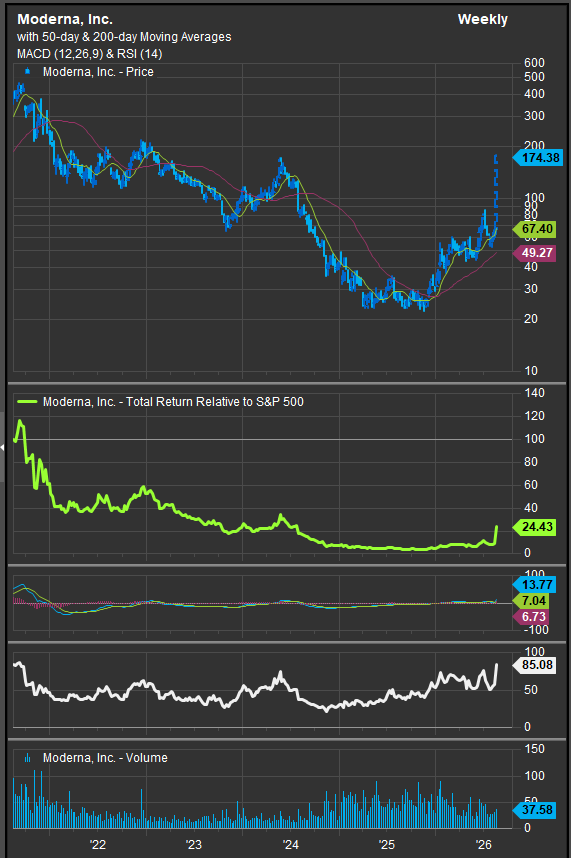
Chart: MRNA’s huge short-term gain comes in the context of a negative long-term performance trend.
The important aspect of the reaction is its breadth. Investors did not treat the result as merely a Moderna event. They treated it as evidence that one of biotechnology’s major technology platforms may have a much larger commercial opportunity.
That distinction explains why funds such as IBB, XBI, ARKG and IDNA all rallied strongly. Moderna’s result increases confidence not only in cancer vaccines but in personalized medicine, immuno-oncology and other approaches that use genetic information to tailor treatments.
There is speculation in the move—Moderna’s valuation reaction assumes potential success beyond melanoma—but there is also a genuine fundamental catalyst.
The Rally Is Bigger Than One Cancer Trial
Moderna ignited the latest move, but biotechnology had already been improving.
The August 20 data shows three-month returns above 30% for IBB, XBI, FBT, BBH and several other biotech funds. That means the leadership change predates this week’s cancer-vaccine announcement.
One reason is that clinical productivity has been improving after several years in which speculative companies were steadily removed from the public market. Fidelity’s midyear sector assessment highlighted biotechnology as one of Health Care’s principal bright spots, citing more favorable clinical readouts, continued M&A and a healthier industry structure after weaker companies lost access to capital.
Recent regulatory developments have reinforced that perception. The FDA approved Replimune’s melanoma treatment earlier this month after previous regulatory setbacks, while regulators recently indicated willingness to review additional data from Capricor Therapeutics’ Duchenne muscular-dystrophy program rather than simply rejecting it. These are company-specific decisions, but collectively they have reduced some of the extreme regulatory pessimism embedded in biotechnology valuations.
Biotech is therefore benefiting from something the AI trade enjoyed earlier in its cycle: positive fundamental surprises arriving against relatively skeptical expectations.
M&A Is Putting a Floor Under Valuations
The second major catalyst is dealmaking.
Large pharmaceutical companies face one of the largest patent-expiration cycles in the industry’s history. Reuters estimated earlier this year that more than $300 billion of revenue could become vulnerable to patent expirations over the next five years, forcing large drug companies to replenish their pipelines through acquisitions and licensing deals. Biotech M&A reached $84 billion in the first quarter alone, nearly double the year-earlier level.
IQVIA subsequently estimated that biopharma M&A reached approximately $130 billion during the first half of 2026, nearly matching all of 2025.
That matters particularly for smaller biotechnology companies. A promising Phase 2 or Phase 3 asset is not being valued solely on its eventual standalone earnings potential; investors also have to consider what that asset may be worth to Merck, Lilly, Novartis, Gilead or another pharmaceutical company facing a pipeline gap.
The M&A environment gives biotechnology a catalyst that is largely independent of the economic cycle—and very different from the capital-spending dynamics driving AI.
Lower Yields Help, but They Are Not the Main Story
Interest rates are providing another tailwind.
Biotechnology is one of the market’s longest-duration industries. Many companies spend cash today for therapies whose potential revenues may not arrive for years. Higher discount rates therefore punish biotech valuations disproportionately, while declining yields can provide meaningful relief.
Long-term Treasury yields fell sharply Wednesday after the Treasury announced plans to increase long-dated bond buybacks, reversing part of the recent global bond selloff.
That helped biotechnology, but rates cannot explain a three-month move of more than 30% in major biotech ETFs. Nor can they explain why biotechnology dramatically outperformed other long-duration industries this week.
Rates are an amplifier. Clinical success and improving industry fundamentals are the catalyst.
What About AI?
AI absolutely matters to biotechnology—but it is not primarily why biotech is outperforming today.
The technology is increasingly being used to identify drug targets, model proteins, design molecules, select trial participants and reduce development timelines. Insilico Medicine says its combination of AI and automated research has reduced the time required to reach a developmental drug candidate from roughly 4½ years using conventional approaches to about one year. GSK recently entered an AI drug-discovery partnership with Relation Therapeutics, and Schrödinger continues integrating AI into computational drug discovery.
AI therefore strengthens biotechnology’s long-term productivity story. If it lowers the cost of failed experiments or allows researchers to identify viable drug candidates earlier, the economics of R&D could improve substantially.
But Moderna’s cancer vaccine did not rally because investors discovered a new AI model. Biotech M&A is not accelerating primarily because pharmaceutical companies want AI exposure. And the current rally in immuno-oncology, mRNA and genomics is being driven by clinical outcomes.
AI is becoming a tool biotechnology uses, not the investment thesis biotechnology is replacing.
So Has Biotech Replaced AI?
In short-term market leadership, yes. In structural leadership, no.
The August 20 data shows one of the clearest leadership rotations of the year. Biotech ETFs are producing high-single- and double-digit weekly gains while semiconductors, software and robotics correct. More importantly, those gains are broad enough to extend beyond one company.
But the flow evidence remains much smaller than the AI trade. Biotech has about $1.5 billion of YTD inflows versus nearly $29 billion across semiconductors, software and robotics/AI. Even after this week’s rally, biotechnology’s one-month aggregate flows remain negative.
That makes biotech an emerging leader, not yet the new dominant market theme.

Chart: ARKG and many other Biotech funds have been basing over the long-term. 2026 has been a bullish pivot after several lean years.
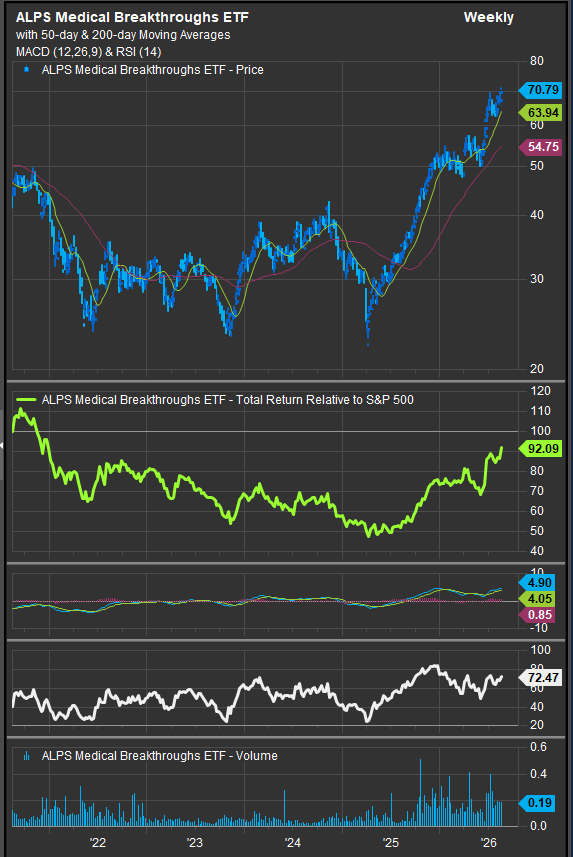
Chart: SBIO has been a top performer in 2026. Down cap. Biotech has been an alpha source YTD.
The more compelling interpretation is that market leadership is broadening. AI infrastructure has moved from an underowned secular opportunity into a heavily financed and crowded trade. Biotechnology is moving in the opposite direction: expectations were low, valuations had been compressed, capital discipline improved, M&A accelerated and clinical results are beginning to surprise positively.
That is the setup from which new leadership often develops.
The next test is flows. If biotechnology continues outperforming and the current $300 million weekly inflow turns into sustained multi-billion-dollar accumulation over the next several months, the argument that biotech has become a genuine market-level leadership theme will become much stronger.
For now, investors are not replacing AI with biotech.
They are discovering that innovation has more than one address.
Sources
- FactSet Research Systems Inc. — August 20, 2026 thematic ETF returns and fund-flow database; source for biotechnology, AI, software and semiconductor return/flow comparisons.
- Reuters — Aug. 19, 2026: Moderna’s personalized mRNA cancer vaccine with Merck’s Keytruda succeeds in a late-stage melanoma trial, triggering a sharp revaluation across Moderna and related biotechnology stocks. Reuters — Moderna cancer-vaccine results
- Reuters Breakingviews — Aug. 19, 2026: Analysis of how much future oncology success is implied by Moderna’s post-trial valuation surge. Reuters Breakingviews — Moderna valuation analysis
- Fidelity Institutional: Midyear Health Care sector review highlighting biotechnology’s improving clinical pipeline, healthier industry structure and continued M&A support. Fidelity — Equity sector midyear update
- Reuters — Aug. 6, 2026: FDA approval of Replimune’s melanoma therapy, supporting the improving regulatory and clinical backdrop for biotech. Reuters — Replimune FDA approval
- Reuters — May 1, 2026: Big Pharma’s approaching patent-expiration cycle is accelerating biotechnology acquisitions and licensing activity as established drugmakers replenish pipelines. Reuters — Big Pharma M&A and patent cliff
- IQVIA — July 2026: Midyear analysis estimating roughly $130 billion of biopharma M&A during the first half of 2026. IQVIA — 2026 biopharma M&A update
- Reuters — Aug. 19, 2026: Bond-market coverage of the decline in longer-term Treasury yields, providing context for the improving discount-rate environment for long-duration biotechnology assets. Reuters — Global markets and Treasury yields
- Reuters — July 23, 2026: Insilico Medicine’s CEO discusses how AI can reduce drug-discovery timelines, supporting the article’s conclusion that AI is an important biotech productivity catalyst rather than the primary cause of the current rally. Reuters — AI and drug discovery
Disclaimer: This material is provided for informational and educational purposes only and does not constitute investment advice, an offer, solicitation or recommendation to buy or sell any security, biotechnology company, exchange-traded fund or other investment product.
Biotechnology investments can involve substantial volatility and company-specific risks, including clinical-trial outcomes, regulatory decisions, financing requirements, patent protection, competition, commercialization risk and dependence on merger-and-acquisition activity. Thematic ETF returns and fund flows are historical observations and should not be interpreted as indicators of future performance or fundamental value.
References to artificial intelligence, drug discovery, individual companies and ETFs are illustrative and do not represent portfolio recommendations. Past performance does not guarantee future results. Investors should review each fund’s prospectus and consider their investment objectives, risk tolerance, time horizon and existing portfolio exposures before investing.
