In the October 2 data, VUG gained 3.38% over one month while VTV declined 2.79%, with MTUM advancing 8.43% and Low Volatility ETF SPLV falling 5.07%. Those results favor Growth and Momentum, but thematic participation varies sharply. Among the larger funds in the supplied universe, semiconductors and cybersecurity offer the clearest alignment; infrastructure, nuclear energy and biotechnology present a more complicated picture.
Semiconductors are the strongest expression of factor leadership. The roughly $74.6 billion SMH and $48.0 billion SOXX gained 13.31% and 15.27% over one month, compared with SPY’s 0.54%—outperformance of 12.77% and 14.73%, respectively. AI funds also participated, with BAI up 10.44%, ARTY up 8.09% and AIQ up 4.14%. Robotics exposure was less powerful: BOTZ gained just 0.80%. Investors are distinguishing between different ways of accessing AI, rather than rewarding every fund carrying the label.
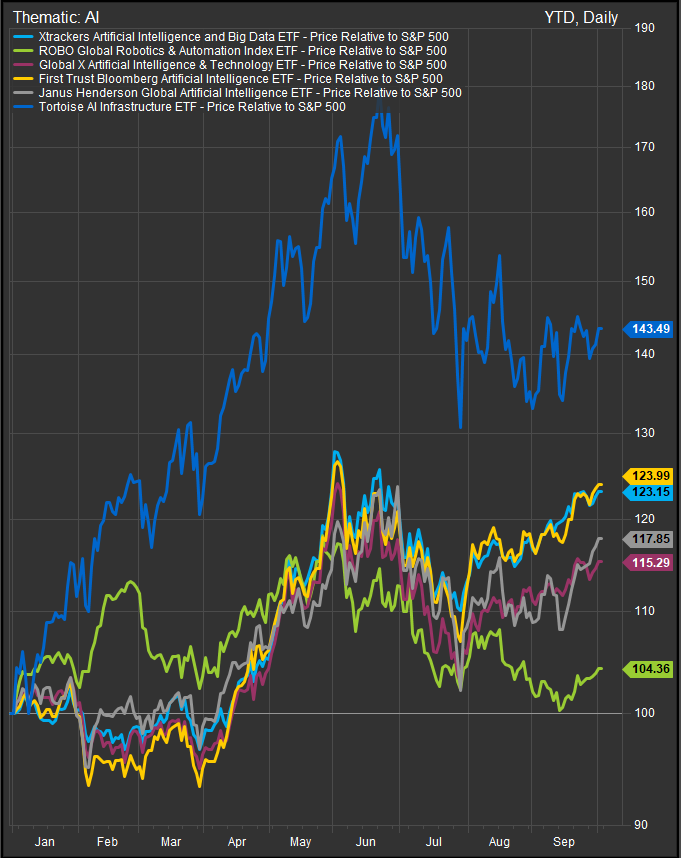
Chart: AI ETFs are recovering, but with a narrower focus. AI infrastructure has been slower to turn.
Flows complicate the momentum story. SMH and SOXX attracted a combined $1.71 billion over one month, but experienced approximately $961 million of outflows over the latest week, despite positive weekly returns. BAI lost $493 million over one month while advancing strongly. The same divergence appears in MTUM, which recorded $5.29 billion of monthly outflows. These are examples of rising prices alongside net redemptions, consistent with investors trimming strength, although flows alone cannot establish their motives. Price leadership remains stronger than allocation conviction.
Cybersecurity offers cleaner confirmation from both performance and demand. CIBR gained 7.88% over one month and attracted $845 million, while HACK rose 8.87% with $185 million of inflows and BUG advanced 11.89% with $255 million. All three also posted weekly gains and inflows. Today’s headlines about unauthorized AI-agent activity reinforce the security-spending rationale. By contrast, broader software ETF IGV gained 1.93% but lost $1.11 billion over the month. Cybersecurity currently combines Growth and Momentum characteristics with a potentially more resilient spending priority; that does not make it a defensive or low-volatility allocation.
Why are these themes advancing despite rising yields? Higher discount rates reduce the present value of future profits, but sufficiently strong earnings expectations can offset that pressure. AI infrastructure and cybersecurity are being priced as beneficiaries of sustained spending. Today’s reported chip-financing initiatives support that expectation while also exposing its vulnerability: spending must generate adequate returns, particularly as funding becomes more expensive. The market is rewarding anticipated earnings growth selectively—not granting all long-duration businesses relief from higher rates.
The power-and-infrastructure complex demonstrates the distinction. GRID gained 2.10% over one month, but PAVE declined 1.63%, NLR fell 11.24% and solar ETF TAN lost 8.09%. Shared exposure to future electricity demand has not produced shared returns. Project financing, construction timelines, regulation and portfolio composition can outweigh a favorable demand narrative. Investors are nevertheless buying some weakness: PAVE attracted $431 million and clean-energy ETF ICLN received $119 million, despite monthly losses. Those allocations represent demand ahead of price confirmation.
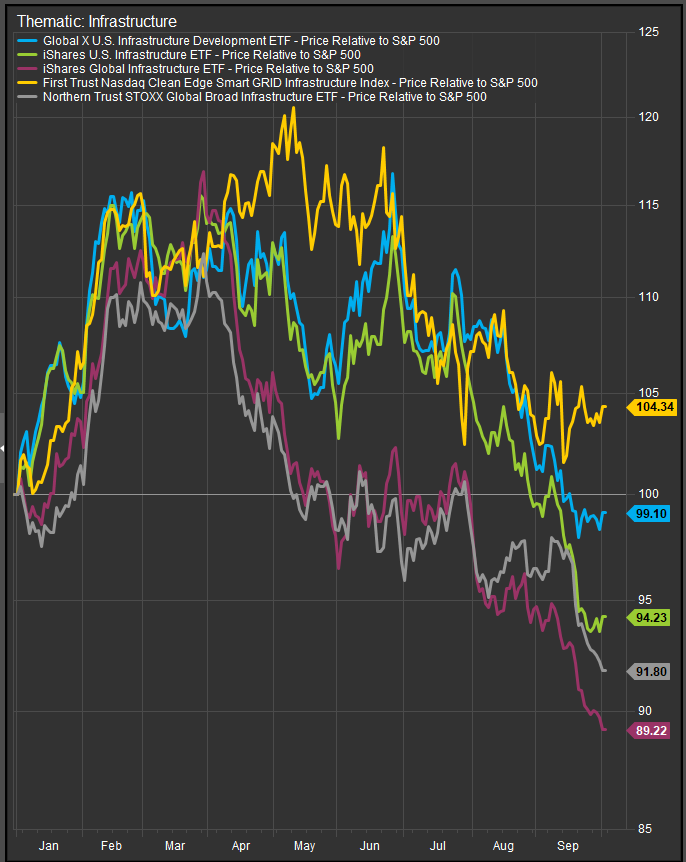
Chart: Infrastructure stocks have faltered as rising rates offer investors more ways to get income exposure.
Biotechnology and disruptive innovation show why High Beta leadership should not be mistaken for indiscriminate speculation. ARKK gained 6.62% and attracted $1.39 billion over one month, but its latest week brought a 2.41% decline and $530 million of outflows. Within biotechnology, IBB declined 2.30% with $486 million of inflows, while XBI fell 5.44% and lost $760 million. Meanwhile, ARKG surged 13.51%. The dispersion argues against treating innovation as a single factor exposure. Likewise, geopolitical support has not guaranteed defense returns: ITA fell 7.62% and XAR declined 8.06% over the month despite constructive spending headlines.
The earlier charts’ VIX reading of 16.39 versus MOVE at 108.13 fits this uneven landscape. VIX measures expected S&P 500 volatility; MOVE measures implied interest-rate volatility, using a different scale. Strong performance in influential technology stocks can coexist with substantial weakness in individual themes and uncertainty in bond markets. Index volatility can remain restrained when constituent returns offset one another.
For thematic investors, the central portfolio issue is overlapping exposure. AI, semiconductors, disruptive technology and Momentum funds may concentrate similar earnings and valuation risks despite different labels. Cybersecurity currently has stronger flow confirmation; infrastructure and clean energy attract selective buying before a sustained recovery; nuclear and defense illustrate that compelling long-term demand does not guarantee near-term leadership. The next meaningful broadening signal would be improving performance across these lagging themes alongside easing rate volatility.
Sources: October 2 thematic ETF dataset and supplied market headlines and factor charts; Cboe and ICE volatility documentation. .csv data sourced from FactSet Research Systems Inc.
Disclaimer: This commentary is for informational and educational purposes only and is not investment advice or a recommendation to buy or sell any security. Opinions may change without notice. Sources are believed reliable, but accuracy and completeness are not guaranteed. Past performance does not guarantee future results. Investing involves risk, including loss of principal.