

ETF Deep Dives connect the macro narrative to relevant targeted exposures within our curated ETFThemes.com ETF Database.
The Chinese equity market is a poster child of the AI themes concentrated outperformance dynamic. CNXT is outperforming because it owns the part of China’s equity market that is working: AI infrastructure, optical networking, batteries, automation, advanced manufacturing and industrial technology. It is not a broad China recovery vehicle. It is a concentrated A-share growth fund tied to China’s new capital-spending cycle.
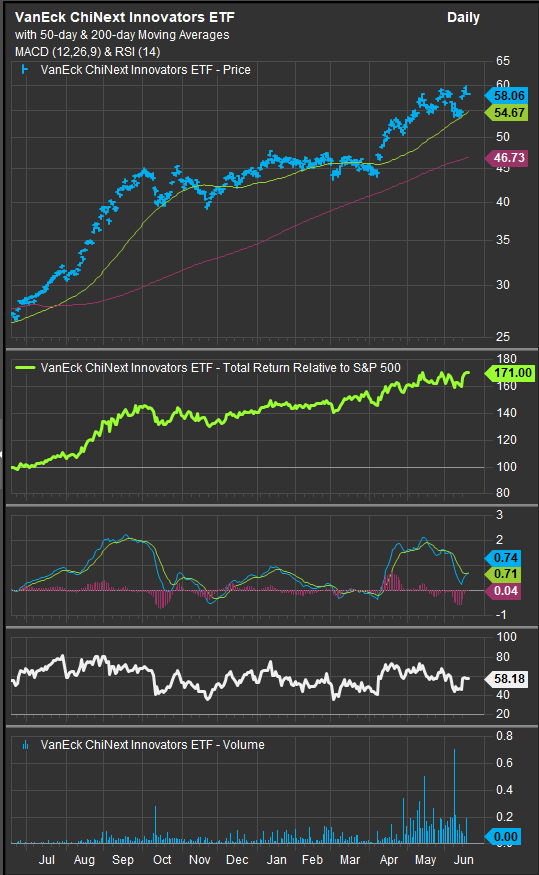
Chart: Funds like CNXT show the continued centrality of AI to the equity market’s bull narrative. However, successful AI implementation remains in the speculative realm.
That distinction matters because China’s cycle is increasingly uneven. Industrial production rose 4.5% year-over-year in May, while high-tech manufacturing rose 15.1%. But retail sales fell 0.6%, fixed-asset investment weakened, and property investment remained deeply negative. This is not a broad consumer-led expansion. It is a supply-side recovery driven by manufacturing, exports, automation, AI infrastructure and policy-directed investment, while households, property and private-sector confidence remain under pressure.
CNXT is built for that environment. The ETF tracks Shenzhen ChiNext companies and is heavily exposed to innovation-oriented A-shares rather than the internet platforms, banks, consumer names and property-linked sectors that weigh on broader China benchmarks. Its largest holdings include Zhongji Innolight, CATL and Eoptolink, giving the fund direct exposure to optical modules, batteries, data-center interconnects and advanced manufacturing.
The key reason CNXT is outperforming is that its holdings sit closer to the AI bottlenecks. Zhongji Innolight and Eoptolink for example benefit from demand for high-speed optical modules and transceivers used in AI data centers. CATL provides exposure to batteries and energy storage. Inovance, Sungrow, Victory Giant and other holdings add exposure to automation, power electronics and electronics manufacturing. These businesses benefit from capital spending, supply-chain localization and AI infrastructure demand rather than relying on a rebound in Chinese consumer spending.
That is very different from Alibaba and Tencent. Both are investing aggressively in AI, but investors are still asking whether those investments will improve margins quickly enough to offset weak consumption, platform competition and rising capex. Alibaba and Tencent remain important long-term companies, but they are tied to e-commerce, advertising, cloud pricing, gaming and consumer confidence. CNXT’s winners are tied more directly to production, infrastructure and scarcity.
This also explains why CNXT has done better than broad China and China internet ETFs. MCHI and FXI carry more exposure to large benchmark weights, including platform internet, financials and state-linked cyclicals. KWEB is more directly exposed to consumer internet and AI monetization. CNXT is more focused on the industrial innovation side of the market: AI hardware, optical networking, robotics, batteries, semiconductors and automation.
The risk is that CNXT is concentrated and momentum-sensitive. The ETF’s top holdings account for a large share of assets, and many of its winners have already priced in strong growth expectations. A slowdown in global AI capex, weakness in optical-module pricing, battery margin pressure, export-control escalation or a reversal in China’s A-share growth trade could create sharp drawdowns.
Still, CNXT’s outperformance is telling investors something important. China’s equity leadership has shifted away from broad reopening and consumer internet toward industrial innovation. For investors who want China exposure tied to AI infrastructure, automation and advanced manufacturing, CNXT offers a cleaner expression than broad China beta. For investors looking for a consumer/property recovery, broader vehicles such as MCHI, FXI or KWEB may be more relevant, but they are not capturing the same new-economy capex cycle. While the market continues its clear delineation in performance managing AI vs. non-AI exposures is a key piece of the puzzle.
Sources
- VanEck CNXT fund materials, including the fund’s ChiNext innovation mandate and current top holdings, led by Zhongji Innolight, CATL and Eoptolink.
- Reuters on China’s May activity data, showing industrial output up 4.5% y/y, high-tech manufacturing up 15.1%, retail sales down 0.6%, fixed-asset investment down 4.1%, and property investment down 16.2%.
- Reuters on China’s AI-consumption policy, including 17 measures to integrate AI into consumer goods and services, including intelligent electronics and humanoid robots.
- Reuters on Zhongji Innolight, reporting a potential Hong Kong listing of up to $7B, reflecting investor demand for China’s AI optical-module supply chain.
- Reuters on China’s nationwide AI buildout, including reporting on a proposed $295B plan to fund data centers and emerging technologies such as quantum computing and humanoid robots.
- ETF Research Center / CNXT holdings data, showing CNXT’s concentration in CATL, Zhongji Innolight, Eoptolink, Sungrow, East Money, Victory Giant, TFC Optical and Inovance.
Disclaimer
This material is for informational and educational purposes only and should not be considered investment advice, a recommendation to buy or sell any security, ETF or market, or a solicitation to engage in any investment strategy. China-focused equities and ETFs may involve elevated volatility, liquidity risk, currency risk, regulatory risk, geopolitical risk, accounting risk, A-share access risk, concentration risk and sensitivity to changes in Chinese policy, U.S.-China relations, tariffs, export controls, domestic demand, property-market conditions, interest rates and global technology spending. ETF holdings, performance figures and macroeconomic data are based on sources believed to be reliable but have not been independently verified. Past performance is not indicative of future results. Investors should consult their own financial, tax and legal advisers before making investment decisions.
